
Scoring sourdough: how to get an ear and good oven spring
By Ashleigh Stent · 8 min read
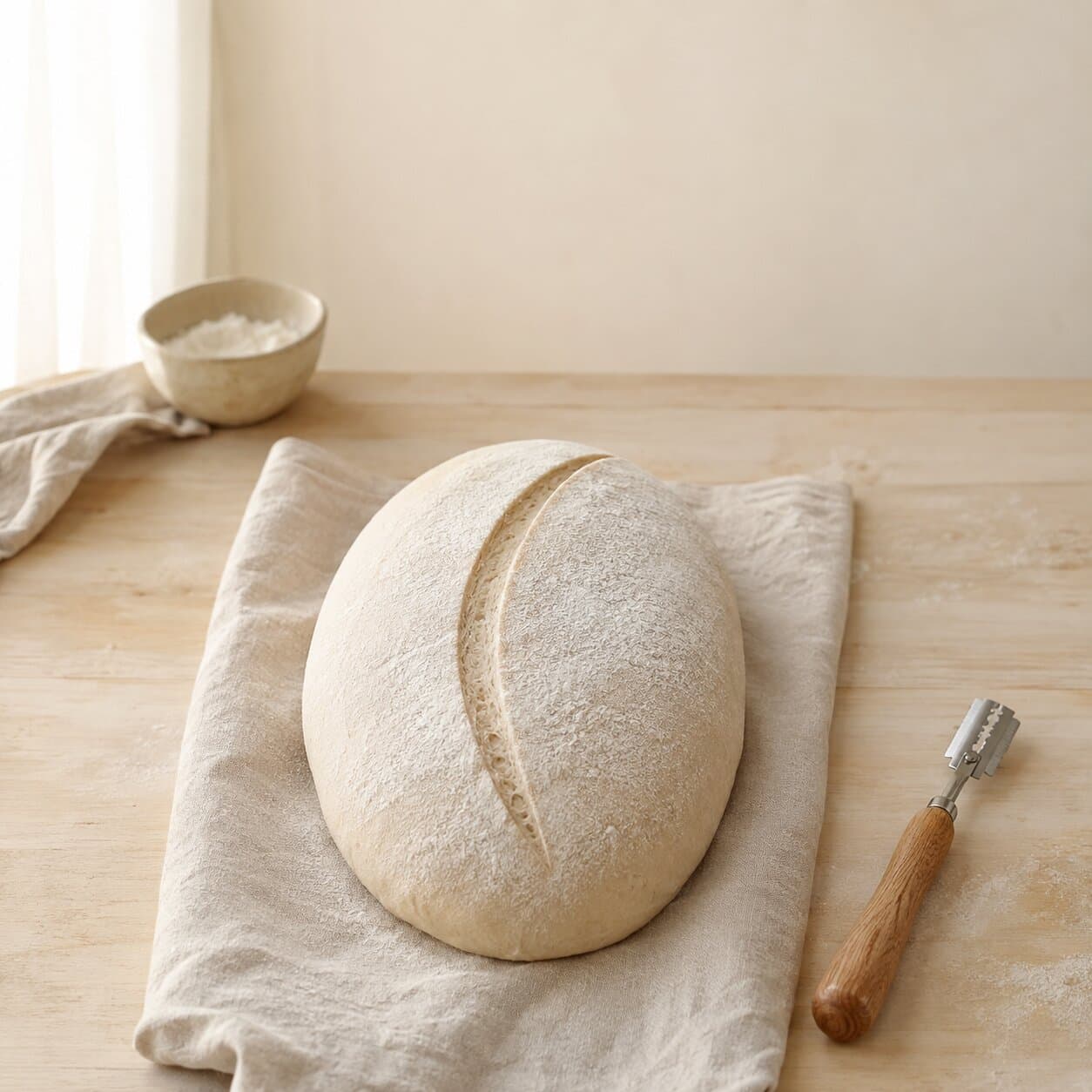
Scoring is the cut you make in the top of a loaf just before it goes in the oven, and it is the step that makes a sourdough look like a sourdough. It is also widely misunderstood. People treat it as decoration, get frustrated when the pretty pattern disappears, and miss the one cut that actually does the work. This is what scoring is for, the single cut that matters, and how to get the prized ear and a tall, open loaf.
Why we score at all
In the first ten minutes in a hot oven, the trapped gas in the dough expands rapidly. This burst of growth is called oven spring. The dough has to open somewhere to release that pressure, and if you do not give it a deliberate weak point, it will tear itself open at a random spot, usually along the side or the base where it looks ugly and bursts unevenly.
Scoring is simply choosing where that opening happens. A clean cut tells the loaf where to expand, so it rises up and out along the line you made instead of blowing out the side. Everything else about scoring, all the wheat sheaves and leaves you see online, is decoration layered on top of that one functional job.
The one cut that matters
Forget patterns to start with. The most reliable score is a single long cut, slightly off-centre, running most of the length of the loaf. That one cut gives the loaf a clear place to open and almost always produces a good result. Master it before you attempt anything fancier, because a confident single slash beats a timid intricate pattern every time.
Use a proper blade. A lame, which is a thin razor blade on a handle, or just a clean razor blade, will glide through the surface. A kitchen knife drags and tears the skin of the dough, which is exactly what you are trying to avoid.
How to get an ear
The ear is that raised, crisp flap that lifts up along the score, and it is the thing experienced bakers chase. It comes from the angle of the cut, not from skill you do not have. Instead of cutting straight down, hold the blade at a shallow angle, around 30 degrees to the surface, and slice so you are creating a thin flap of dough rather than a vertical trench.
As the loaf springs in the oven, that flap gets pushed up and out, sets in the heat, and becomes the ear. Three things make it far more likely:
- A shallow angle on the blade, so you cut under a flap rather than straight down.
- Cold dough. A loaf scored straight from the fridge holds the cut cleanly. Warm slack dough sags and the ear collapses.
- Good steam and a hot oven. Steam keeps the surface soft long enough to expand before it sets, which is what lets the ear lift at all.
Depth, angle and confidence
For the main expansion cut, go reasonably deep, around a centimetre. A shy, shallow score will not open properly and the loaf bursts elsewhere anyway. For decorative cuts, keep them shallow so they do not compete with the main one for the spring. And cut quickly and in one stroke. Hesitation makes the blade stick and drag, which is the usual reason a score looks ragged.
Simple patterns that work
- The single slash: one long off-centre cut. The most reliable score there is, and it gives the best ear.
- The cross or square: good for round loaves, opens evenly in four directions.
- The chevron: one main slash with a few shallow angled cuts alongside for looks, without sacrificing the spring.
If a loaf still bursts at the side despite a good score, the usual culprit is underproofing rather than the scoring itself. An underproofed loaf has too much gas left to release and will find its own way out. Reading the proof correctly, covered in the guide to telling when sourdough is proofed, fixes more scoring problems than any blade technique.
Bake a loaf worth scoring with the classic white sourdough recipe, and get your weights from the calculator.
Keep reading
- Same-day vs overnight sourdough: cold dough scores best
- Sourdough troubleshooting: including the flat loaf