
8 common sourdough mistakes (and how to fix them)
8 min read
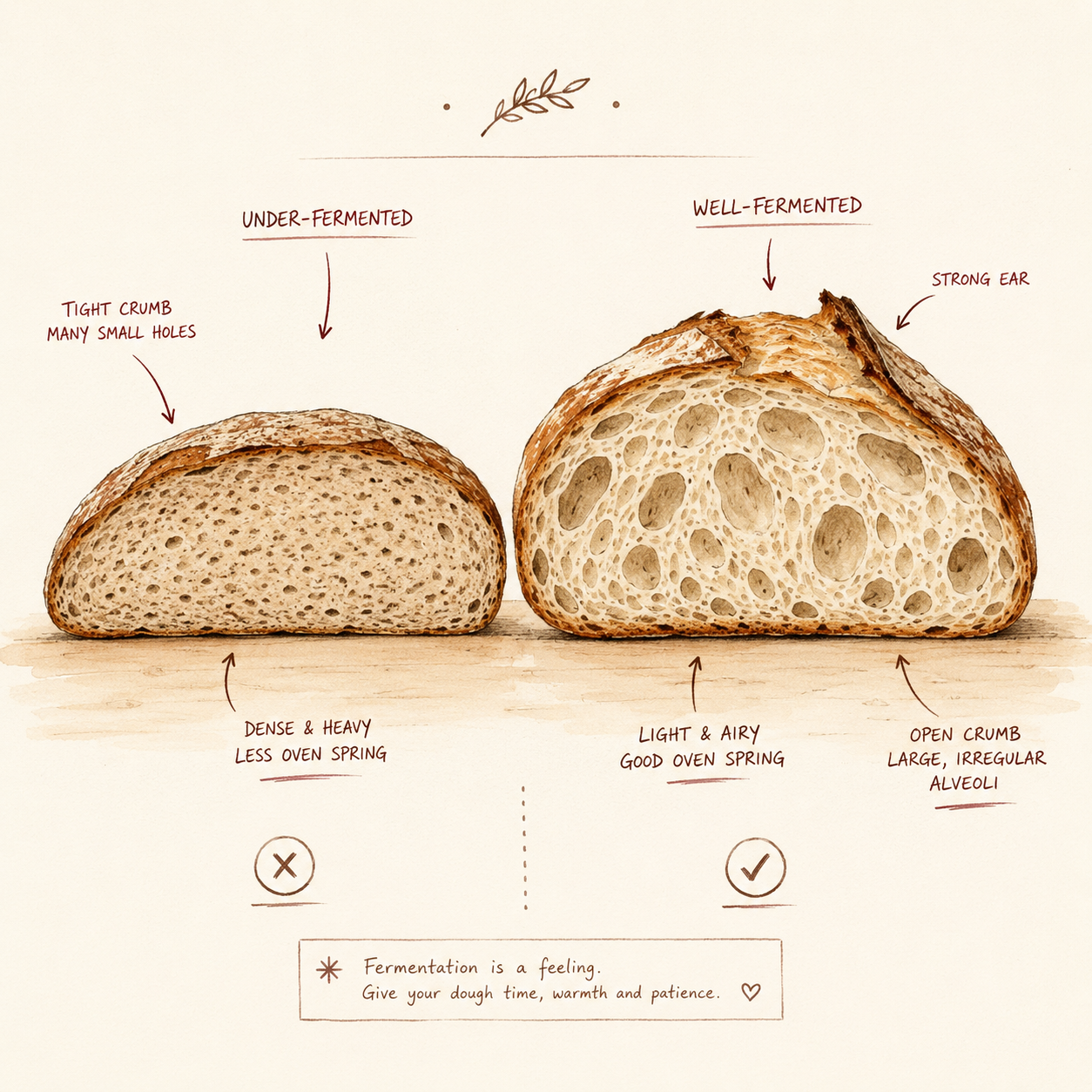
Almost every sourdough problem comes down to one of about eight things. Once you can recognise which one is happening, the fix is usually small and specific — not a complete rebuild of your process. Here is the catalogue of common mistakes, what each one looks like, and exactly what to change next bake.
1. Dense, tight crumb
What it looks like: The loaf is heavy, the slice has very small holes, and it feels gummy or doughy near the centre even when cooked through.
Why it happens: Almost always underproofing. Your starter wasn't active enough when you mixed, or bulk fermentation was too short, or the kitchen was colder than you thought. The dough didn't develop enough gas to support an open crumb.
The fix: Use your starter at peak (domed, full of bubbles, just starting to flatten). Watch the dough, not the clock — bulk is done when the dough has risen by about 50 to 75%, looks domed and shows bubbles on the surface and sides of the bowl. In a cold kitchen, bulk can take 8 hours or more.
2. Pancake-flat loaf
What it looks like: When you turn the dough out of the banneton it spreads sideways instead of holding its shape. Little to no oven spring.
Why it happens: Overproofing, or weak shaping, or both. The gluten has been broken down by fermentation and can no longer hold structure.
The fix: Cut bulk fermentation shorter — pull it before the dough looks fully risen. Shape tighter: gather the dough into a ball with surface tension, let it rest 10 minutes, then pre-shape and final shape with confidence. Use a banneton or tea-towel-lined bowl, not a flat surface, for the cold proof.
3. Gummy, wet interior
What it looks like: The crust looks great but when you slice in, the crumb is sticky and pasty. It feels underdone even after a full bake.
Why it happens: Either undercooked (most common) or cut too early. Sourdough continues to cook for an hour after coming out of the oven — slicing into a warm loaf releases steam that should have set the crumb.
The fix: Bake longer uncovered, ideally to an internal temperature of 96°C (probe with a kitchen thermometer through the bottom). Then — and this is the part everyone skips — cool fully on a wire rack for at least 60 minutes before slicing. Two hours is better.
4. Pale, soft crust
What it looks like: The crust is golden-blond rather than deep mahogany, and it's chewy rather than crisp.
Why it happens: Oven not hot enough, Dutch oven not preheated long enough, or lid kept on too long. The Maillard reaction that browns the crust needs both heat and steam to work.
The fix: Preheat your Dutch oven at 250°C for at least 45 minutes before the loaf goes in. Bake covered for 20 minutes, then remove the lid for the final 20 to 25 minutes. The loaf should be deep brown, almost on the edge of burnt-looking, before you take it out.
5. No ear, no expansion
What it looks like: The loaf comes out the right shape but the score line stayed where you put it. There's no lifted, flared ridge on top.
Why it happens: Score is too shallow, at the wrong angle, or made too long before baking. The ear is created when the dough bursts open along the score during oven spring.
The fix: Score with the blade held at about 30° to the surface, cutting about 1cm deep. Use a fresh, sharp blade — a serrated knife works fine if it's sharp. Score immediately before the loaf goes in the hot oven, not minutes earlier.
6. Sticky, unworkable dough
What it looks like: The dough is so wet you can't shape it without it sticking to everything. Stretch and folds turn into a sticky mess.
Why it happens: Either the hydration is too high for the flour you're using, or the flour is too weak (low protein), or you didn't develop enough gluten early on.
The fix: Use strong bread flour (12% protein or higher). Wet your hands before handling the dough — wet hands don't stick. If you used wholemeal flour, drop the hydration by 3%; wholemeal absorbs more water than white. And do the first set of stretch and folds 20 minutes after mixing, while the dough is still firm.
7. Sour flavour too strong (or too mild)
What it looks like: The loaf tastes aggressively tangy, almost vinegary. Or, the opposite — it tastes plain and bread-like without any sourdough character.
Why it happens: Sourness comes from acetic acid produced during cold fermentation. Long cold proofs make sourer bread. Short cold proofs (or no cold proof) make milder bread.
The fix: Want more sour? Extend the cold proof to 24 to 36 hours and use a slightly stiffer starter. Want less sour? Cold proof for only 8 to 12 hours, or bake straight after a long room-temperature bulk. The flavour is a dial you control.
8. Loaf split along the side, not the score
What it looks like: The score you made on top stayed closed and the bread instead burst open along one side or the bottom.
Why it happens: The dough went into the oven with the most fragile spot somewhere other than where you scored. Often this is the seam from shaping.
The fix: Score deeper, at a clearer angle. Make sure the seam from shaping is on the bottom when the loaf goes into the Dutch oven (or on top, if your recipe calls for that). And don't score in multiple shallow places — one decisive cut is better than three timid ones.
The pattern
If you look at the eight mistakes together, most of them are some variation on the same root problem: judging fermentation by time instead of by what the dough is actually doing. A recipe that says "bulk for 4 hours" assumes a 22°C kitchen and a peak starter. Yours might be 18°C with a sluggish starter, in which case 4 hours isn't enough. The single biggest improvement you can make to your sourdough is to stop watching the clock and start watching the dough.
Keep reading
- Sourdough for beginners — the complete starter guide
- Sourdough starter troubleshooting — fixing the starter, not the bake
- Stretch and fold, explained — strengthening the dough
- Classic white sourdough recipe — a reliable baseline bake
Want exact ingredient weights for any size or hydration? Use the calculator.