
Baker's percentage, explained
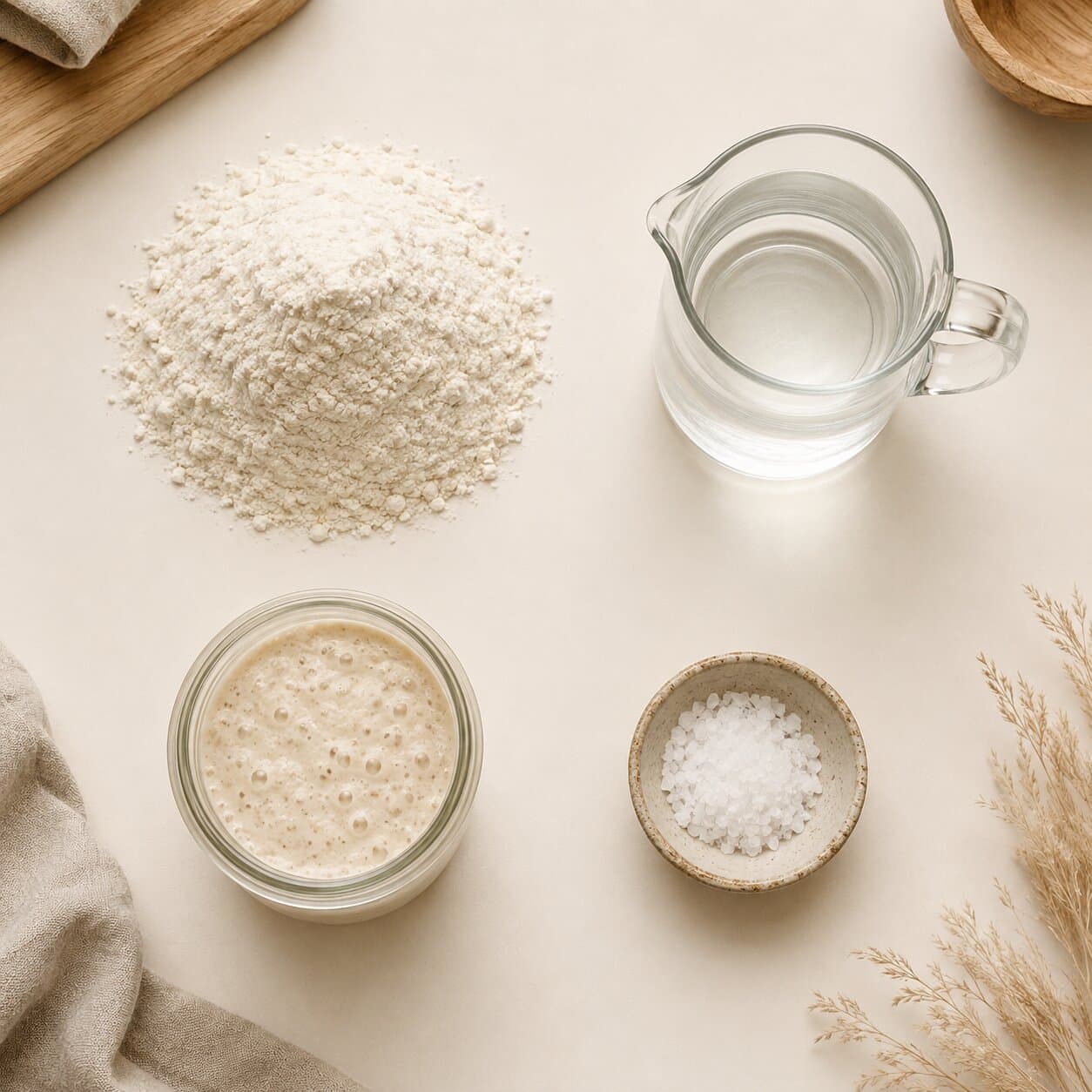
Baker's percentage is how professional bakers write recipes, and once it clicks it changes how you read every recipe you ever see again. Every ingredient is expressed as a percentage of the total flour weight. Flour is always 100 percent. Water at 72 percent means 72g of water for every 100g of flour. Salt at 2 percent means 2g of salt for every 100g of flour. The flour is the anchor, and everything else is measured against it.
The one thing that trips people up at first: the percentages do not add up to 100. They add up to whatever they add up to, usually somewhere around 190 percent for a sourdough. That is fine. They are not slices of a pie, they are ratios against the flour.
Why bakers do it this way
It scales effortlessly. Whether you are baking one 800g loaf or twenty 1kg loaves, the percentages stay the same and you just multiply the flour weight. It also makes recipe comparison meaningful: when someone says "75 percent hydration", you know exactly what they mean regardless of batch size, and you can compare two recipes that use completely different quantities at a glance.
It also makes adjusting a recipe trivial. Want a wetter dough? Raise the water percentage and leave everything else alone. Want more loaves? Multiply the flour and let every other weight follow. You are never juggling four numbers at once, you are turning one dial at a time.
The standard sourdough percentages
- Flour: 100 percent, by definition. This is the anchor everything else is measured against.
- Water: 60 to 85 percent, depending on the crumb you want and the flour you are using. See the hydration guide for how to choose.
- Starter: 10 to 30 percent. Most home bakers settle in at 15 to 25 percent. More starter ferments faster, less starter ferments slower and gives you a longer window.
- Salt: 2 percent, almost universal. It controls fermentation speed and tightens the gluten as well as seasoning the bread.
A worked example
Say you want a single loaf and decide to use 500g of flour at 72 percent hydration, 20 percent starter and 2 percent salt. Multiply each percentage by the flour weight:
- Flour: 500g
- Water: 500 times 0.72 = 360g
- Starter: 500 times 0.20 = 100g
- Salt: 500 times 0.02 = 10g
That gives a total dough weight of 970g, which bakes down to roughly an 850g loaf once it has lost a little water in the oven. Every recipe in the world can be reduced to this same four-line sum.
Solving for flour weight from total dough weight
The example above starts from the flour, but more often you start from the other end: you know your tin holds an 800g loaf, and you want to work backwards to the flour. If you know your hydration and starter percentages, you can solve for flour directly:
flour = totalDough / (1 + hydration + starterPct + 0.02)
For an 800g dough at 72 percent hydration and 20 percent starter, that is 800 divided by 1.94, which is about 412g of flour. From there the rest is multiplication. That is exactly the formula our calculator uses, so you never have to do this by hand unless you want to understand it.
A note on starter and total flour
Strictly speaking, the flour and water inside your starter are part of the dough too. A 100 percent hydration starter is half flour, half water by weight, so 100g of starter brings 50g of flour and 50g of water to the party. Serious bakers sometimes account for this to keep their hydration exact. For a home loaf the difference is small, and our calculator handles it for you, so you can ignore it until you are chasing a very specific crumb.
Common mistakes
- Expecting the percentages to total 100. They will not, and they are not meant to.
- Measuring in cups. Baker's percentage only works by weight. A kitchen scale that reads to 1g is the one tool you genuinely need.
- Forgetting to scale the salt and starter when you change the flour. Every weight moves together.
Try the calculator, or jump straight to a worked example: 800g white sourdough at 72 percent hydration.
Keep reading
- Sourdough hydration guide: what the percentage means and how to choose one
- Feeding a sourdough starter: keep your starter active and ready to bake
- How to make a sourdough starter: day-by-day from scratch
- Classic white sourdough recipe: a reliable 800g loaf, step by step