
Scaling a sourdough recipe: what actually changes
9 min read
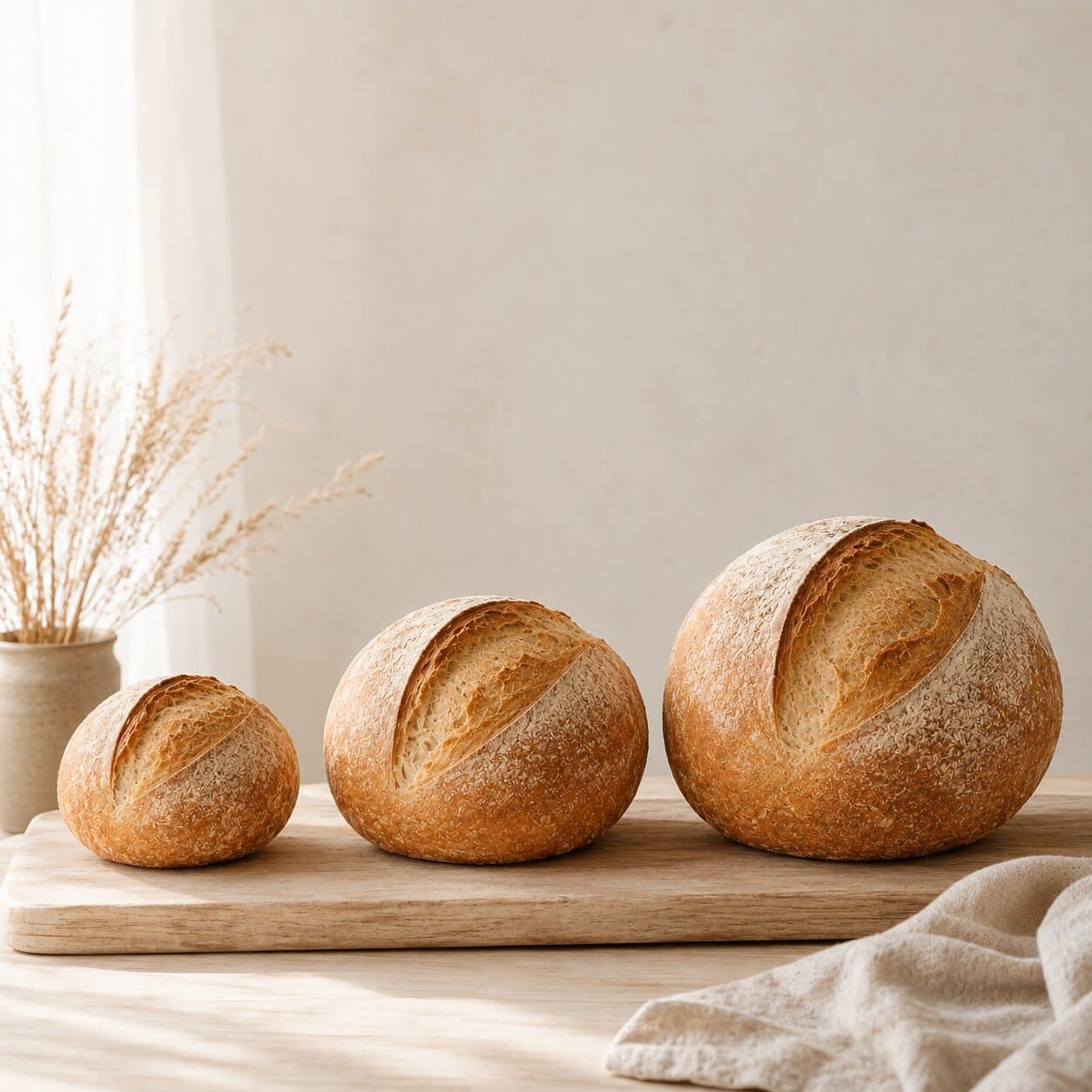
Halving or doubling a sourdough recipe sounds like the most trivial arithmetic in baking, and for the ingredients it genuinely is. Where people come unstuck is assuming that everything else scales the same way. It does not. The ingredients are linear, the geometry is not, and a couple of things that look like they should scale turn out to be ratios that need holding constant instead.
This is worth understanding properly, because it explains a whole category of confusing results: why a small loaf comes out proportionally crustier, why the same recipe ferments at a different rate when you scale it badly, and why "just halve the bake time" produces something unpleasant.
The part that really is linear
Baker's percentage is what makes scaling trivial. Every ingredient is written as a percentage of flour weight, and flour is always 100 percent. So the recipe is not a list of weights at all, it is a set of ratios, and ratios do not care how much bread you are making.
ingredient weight = flour weight × ingredient percentage
Multiply the flour weight by any factor and every other weight moves by exactly the same factor. The percentages, and therefore the dough, are unchanged.
Here are two worked examples straight out of this site's calculator, both at 72 percent hydration with white flour, one at a 1kg finished loaf and one at 500g:
| Ingredient | 1kg loaf | 500g loaf | Ratio |
|---|---|---|---|
| Flour | 546g | 273g | exactly half |
| Water added | 343g | 172g | half, plus rounding |
| Starter | 100g | 50g | exactly half |
| Salt | 11g | 5g | half, plus rounding |
| Total | 1000g | 500g | half |
Every line halves. The only wobble is rounding to whole grams: half of 343 is 171.5 and half of 11 is 5.5, so those two land a gram off. On a 500g loaf a single gram of water is 0.2 percent of the flour weight, which is well inside the error of any domestic scale, and a gram of salt either way is not something you will taste. Round and move on.
What the hydration number is measured against
This is the one piece of bookkeeping that trips up people comparing calculators, and it is worth stating plainly. A 100 percent hydration starter is half flour and half water by weight. So the starter brings flour of its own to the dough, and you have a choice about whether to count it.
This calculator anchors hydration to the flour you add, and handles the starter separately. In the 1kg example that reads as 72 percent. If instead you fold the starter's 50g of flour and 50g of water into the totals, the same dough is 393g of water against 596g of flour, which is 65.9 percent. Nothing about the bread changed. Only the denominator did.
Neither convention is wrong, and both are in common use. What matters is not mixing them, because a recipe written one way and reproduced the other will be noticeably drier or wetter than intended. If a hydration figure from elsewhere feels off against yours, this is the first thing to check.
The part that is not linear: crust
A loaf is roughly a ball, and a ball has an awkward property: volume grows with the cube of the radius while surface area grows with the square. Those two do not keep step, which is why bake time is not proportional to weight.
The arithmetic, written out. Volume is proportional to r³ and surface area to r². Double the dough at the same density and the volume doubles, so the radius grows by the cube root of 2:
radius factor = 21/3 = 1.26
crust area factor = (21/3)2 = 22/3 = 1.59
So twice the bread has 1.59 times the crust, not twice. Turn it around and the small loaf looks even more interesting. A 500g loaf is half the mass of a 1kg one, and 0.52/3 = 0.63, so it carries 63 percent of the crust area across 50 percent of the mass. Divide those and the smaller loaf has 1.26 times as much crust per gram of bread.
That factor of 1.26 is the cube root of 2 again, which is not a coincidence: crust per gram scales with the inverse cube root of mass. It is the same relationship that makes a small potato bake faster than a large one, and it is pure geometry rather than anything to do with sourdough.
The practical consequence follows from the same numbers. Heat has to travel from the surface to the centre, and the centre of the bigger loaf is 1.26 times further in, while the surface available to deliver that heat has only grown by 1.59 times against double the interior to warm. A bigger loaf therefore needs proportionally longer in the oven, and a smaller one needs less than you would guess from the weight. Exactly how much longer depends on your oven, your Dutch oven and your dough, so treat that as a direction to adjust in rather than a number to copy.
Crust-to-crumb ratio
If you like crust, the geometry is telling you something useful: bake smaller loaves. Two 500g loaves have 1.26 times the crust of one 1kg loaf made from the same total dough, for the same reason as above. That is a geometric consequence rather than a claim about flavour, but it does explain why the same recipe split into rolls tastes crustier than it does as one large boule.
It also explains a mild frustration when scaling up. If you love the crust-to-crumb balance of your usual 800g loaf and you double it to feed guests, the loaf you get is not simply a bigger version of the one you liked. It has proportionally less crust. Making two of your usual size preserves the thing you were actually attached to.
Starter does not scale the way people assume
Fermentation speed is governed by the ratio of starter to flour, not by the absolute amount of starter. Keep that ratio fixed and a scaled recipe ferments at the same rate as the original, which is what you want. Change it and the timing moves, even though the recipe looks the same.
This calculator's default starter weight is 10 percent of the finished loaf weight, with a 20g floor for very small bakes. Because it is anchored to loaf weight rather than flour weight, it lands at 18.3 percent of flour in both examples above, which is exactly the scale-invariance you want. It does drift a little across the hydration range, though, from about 17.6 percent of flour at 65 percent hydration to about 19.7 percent at 85 percent, because a wetter dough of the same finished weight contains less flour.
That drift is small enough not to matter for a single bake. It does matter if you are changing hydration and loaf size at the same time and wondering why the timing shifted. In that case the number to hold constant is starter as a percentage of flour, not starter as a percentage of the loaf.
The common scaling mistake here is keeping the starter weight from the larger recipe when you make a smaller loaf, usually because that is what is left in the jar. Halve the flour and keep 100g of starter and you have gone from roughly 18 percent to roughly 37 percent, which ferments substantially faster. The dough is not broken, but the timings in the recipe no longer describe it, and it will be ready long before you look.
Salt stays at 2 percent
Salt is 2 percent of flour weight in this calculator, and that percentage holds at every scale for the same reason the rest of the ratios do. Salt does three jobs, and all three are proportional to how much dough there is: it seasons, it tightens the gluten network, and it moderates fermentation by slowing yeast activity.
Getting it wrong when scaling has a predictable direction. Halve the flour but keep the original salt and you have doubled the salt percentage to around 4 percent, which will noticeably slow fermentation and give a tighter dough, on top of tasting too salty. Go the other way, doubling the flour and forgetting the salt, and you get a slack dough that ferments faster than the recipe expects and reads as flat and bland. Neither is a disaster, and both are avoided by scaling salt with everything else.
Where linear scaling genuinely breaks
The arithmetic keeps working indefinitely. Your kitchen does not. These are limits rather than measured results, and they are the reason professional scaling is not just multiplication:
- Mixer capacity. A stand mixer rated for a certain flour weight will climb and stall past it, and hand-mixing a very large batch is genuinely hard work. Wet dough is worse than stiff dough here.
- Banneton and tin size. Dough that overflows its proofing basket loses the surface tension that shaping built, and the loaf spreads instead of rising.
- Dutch oven volume. This is usually the real ceiling for home bakers. A loaf that fills its pot cannot expand, and one that touches the lid will scorch there. Doubling the dough needs 1.26 times the linear clearance, not double the pot.
- Fridge space. Cold proofing four bannetons is a logistics problem, and a fridge packed solid also circulates air poorly, so different loaves cool at different rates and ferment at different speeds.
- Oven recovery. More cold mass in the oven pulls the temperature down further when the door opens, and a domestic oven takes longer to climb back than a deck oven.
The usual resolution is to stop scaling the loaf and start scaling the number of loaves. Two 800g loaves behave exactly like the 800g loaf you already know, bake in the same time, and keep the crust-to-crumb ratio you chose. One 1.6kg loaf is a different object with different behaviour.
Putting it to work
Open the calculator at 1kg, 72 percent, white and then at 500g, 72 percent, white, and watch every ingredient halve while the percentages sit still. That is the linear part, and it is the part you can trust completely.
Then remember the two numbers that are not linear. Crust area moves with the two-thirds power of mass, so 1.59 times for a doubling. Crust per gram moves with the inverse cube root, so 1.26 times for a halving. Everything else is a ratio, and ratios you just keep.
Keep reading
- Baker's percentage, explained, the system behind the ratios
- Converting cup recipes to grams, with sourced conversion figures
- Sourdough hydration, choosing the right number
- Sourdough troubleshooting, every symptom, cause and fix