
Converting cup-based sourdough recipes to grams
8 min read
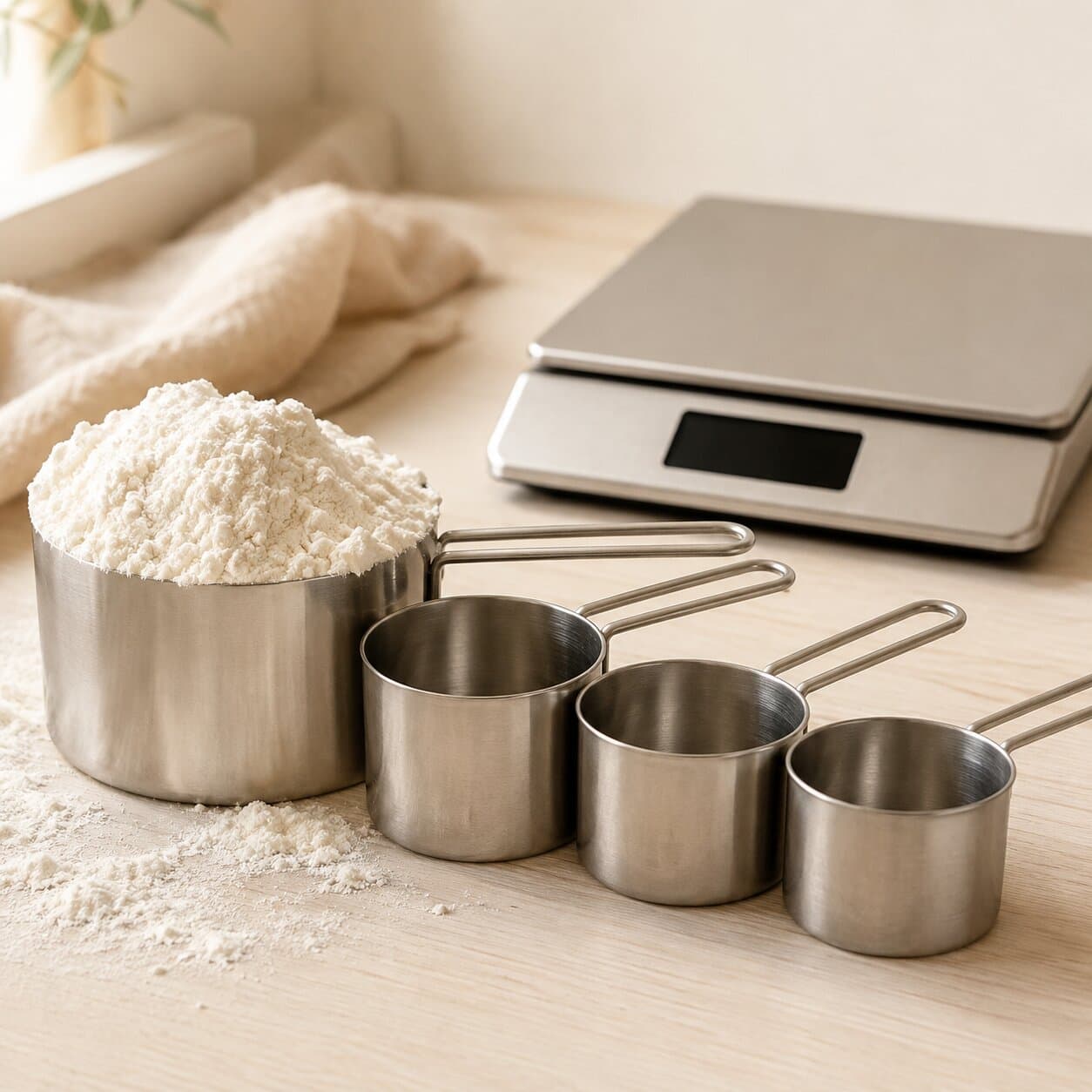
Plenty of good sourdough recipes are written in cups, and if you bake by weight they are frustrating to use. The honest answer to "how do I convert this?" is a maths answer, and it comes with a caveat that matters more than the conversion itself: a cup of flour is not a fixed quantity, so some of the precision you are hoping to recover was never in the original recipe.
This walks through why volume fails specifically for sourdough, gives sourced conversion figures, works out how large the error actually is, and then converts a typical cup recipe end to end.
Why cups fail worse for sourdough than for cake
Hydration is the number that governs how a sourdough behaves, and hydration is a ratio of two weights: water divided by flour. Water is well behaved, because it is incompressible and a cup of it always weighs the same. Flour is not. It is a powder that traps air, so the weight in a cup depends entirely on how the cup was filled.
That means the error goes straight into the denominator of the one ratio you care about. In a cake, a slightly heavy cup of flour gives you a slightly drier cake. In a sourdough, it changes the hydration, and hydration changes how the dough handles, how long it ferments, how open the crumb is and how much you can get away with. This is why two people can follow the identical cup recipe and get doughs that behave nothing alike.
How large is the variation? According to King Arthur Baking, fluffing the flour, sprinkling it into the cup and scraping it level gives around 120g per cup, while more condensed flour means a cup can hold up to 160g. That is a spread of a third of the flour weight, from nothing but technique.
The conversion figures
Every figure below comes from King Arthur Baking's Ingredient Weight Chart. Note the volume column carefully, because it is not "1 cup" for everything: the salts are listed per tablespoon, which is a very easy way to end up with wildly over-salted bread.
| Ingredient | Volume | Weight |
|---|---|---|
| Bread flour | 1 cup | 120g |
| All-purpose flour | 1 cup | 120g |
| Whole wheat flour | 1 cup | 113g |
| Water | 1 cup | 227g |
| Sourdough starter | 1 cup | 227g to 241g |
| Salt, table | 1 tablespoon | 18g |
| Salt, kosher (Diamond Crystal) | 1 tablespoon | 8g |
| Salt, kosher (Morton's) | 1 tablespoon | 16g |
Two things to take from that table. First, wholemeal is lighter per cup than white, 113g against 120g, so a cup-for-cup flour swap quietly changes your flour weight as well as your flour type. Second, look at the salts: a tablespoon of table salt weighs 18g while the same volume of Diamond Crystal kosher weighs 8g, which is less than half. A recipe that says "1 tablespoon salt" without naming the salt is ambiguous by a factor of more than two.
Recipes usually give salt in teaspoons rather than tablespoons, and there are 3 teaspoons in a tablespoon, so divide: table salt is 6g per teaspoon, Morton's kosher is about 5.3g, and Diamond Crystal is about 2.7g.
Starter is the row to trust least, even though the chart gives a figure. Its density depends on how active it is, and a starter at peak is full of gas while the same starter hours later has collapsed and is much denser. The two states can genuinely differ by a third of the weight in the same measuring cup. Half of a 100 percent hydration starter is flour and half is water, so getting it wrong shifts both sides of your hydration ratio at once. Weigh the starter if you weigh nothing else.
Whose cup, though?
There is a second problem hiding underneath the first, and it catches British and Australian bakers in particular. "A cup" is not one internationally agreed volume. A US customary cup is 236.6ml, an Australian metric cup is 250ml, and the older British imperial cup is 284ml.
So a measuring cup bought in the UK can hold about 20 percent more than the one the recipe writer used in the United States, and almost every cup-based sourdough recipe online is written to the American one. The chart above is American, which is why it puts a cup of water at 227g rather than the 250g you would get from filling a metric cup.
Combine that with the scooping error and the two can either cancel out or compound alarmingly, and you have no way of knowing which. It is another argument for skipping the conversion question entirely and working in grams, where a gram is a gram in every country.
How big is the error, exactly?
Worth doing this in full, because the size of the answer is the argument for buying a scale. Take a recipe calling for 3 cups of flour and 1½ cups of water, and change nothing but how the flour went into the cup.
The water is the same either way: 1.5 × 227g = 340.5g, call it 341g. The flour is where it moves:
- Fluffed, spooned and levelled, at 120g per cup: 3 × 120 = 360g. Hydration = 341 ÷ 360 = 94.7 percent.
- Scooped and packed, at 160g per cup: 3 × 160 = 480g. Hydration = 341 ÷ 480 = 71.0 percent.
That is the whole usable range of sourdough in one recipe. 71 percent is a comfortable everyday dough that a beginner can shape without trouble. 94.7 percent is a slack, sticky, expert-level dough that most people would struggle to get into a banneton. The recipe text is identical in both cases. The only variable is how someone filled a cup.
This also explains a specific and very common frustration: following a cup recipe, ending up with something closer to batter than dough, and concluding you did something wrong. You probably did not. You measured your flour more gently than the recipe writer measured theirs.
A worked conversion, end to end
Here is a recipe in the shape most cup-based sourdough recipes take. It is a generic example rather than a specific published recipe, chosen because the quantities are typical:
3 cups bread flour
1¼ cups water
½ cup sourdough starter
2 teaspoons table salt
Applying the chart, and assuming the flour was fluffed and levelled rather than packed:
| Ingredient | Arithmetic | Weight |
|---|---|---|
| Bread flour | 3 × 120 | 360g |
| Water | 1.25 × 227 | 284g |
| Starter | 0.5 × 227 | 114g |
| Salt | 2 × 6 | 12g |
| Total dough | 770g |
Now into baker's percentages, so you can see what the recipe actually is. Against the 360g of added flour, water is 284 ÷ 360 = 78.9 percent, starter is 114 ÷ 360 = 31.7 percent, and salt is 12 ÷ 360 = 3.3 percent.
The starter is 100 percent hydration, so its 114g is 57g of flour and 57g of water. Folding those into the totals gives 417g of flour and 341g of water, which is 81.8 percent hydration, with salt at 12 ÷ 417 = 2.9 percent.
Converting a recipe often tells you something the cups were hiding, and it does here. Salt at 2.9 percent is meaningfully above the 2 percent most bakers use, so this dough will ferment slower than the recipe's timings suggest and will taste quite salty. Starter at 31.7 percent of flour is on the high side too, which pushes the other way and speeds fermentation up. Neither is visible when the recipe is written in cups and spoons. Both are obvious the moment it is written in percentages, and that is the real reason to convert.
If you want to bake the sensible version, open the calculator at 770g and 80 percent hydration and it will give you the weights with salt at a standard 2 percent and a starter proportion that matches the timings in most recipes.
Why a scale is the cheapest fix in baking
A digital kitchen scale costs less than a decent banneton and removes an error worth 24 percentage points of hydration. Nothing else you can buy improves your bread that much for that money.
On precision: 1g resolution is plenty. On a 360g flour weight, 1g is under 0.3 percent, which is far below the point where you could detect a difference in the dough. The only place finer resolution helps is salt on a small batch, where 12g is the target and a 1g error is 8 percent of the salt. Even then it is a seasoning difference rather than a structural one, and it is easily handled by weighing the salt into a separate small dish rather than by buying a better scale.
The other habit worth adopting is the tare button. Put the bowl on, zero it, add flour, zero it again, add water. You get every weight without arithmetic and without a second bowl to wash, and it makes weighing genuinely faster than measuring cups rather than merely more accurate.
Once you are working in grams, keep a note of the percentages rather than the weights. Percentages are what let you scale the recipe, change the loaf size, or compare it against anything else you bake. There is more on that in the guide to baker's percentage.
Keep reading
- Scaling a sourdough recipe, what is linear and what is not
- Baker's percentage, explained, the arithmetic written out
- Sourdough hydration, what the number changes
- Sourdough for beginners, the complete first-loaf guide